Fear as Strength
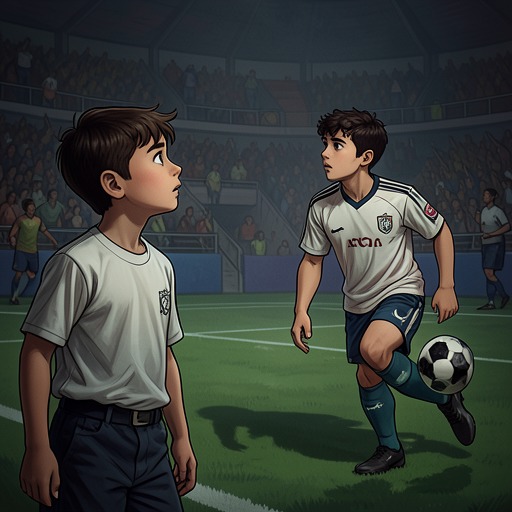
Kevin the Star StrikerFear as Strength is the principle that transforms fear from an apparent weakness into a usable source of courage. In the Wild Soccer Bunch’s struggle against Mickey the Bulldozer and the Unbeatables, fear is not denied or magically removed; it is named, shared, interpreted, and converted into attention, trust, movement, and teamwork. The idea therefore challenges the brutal model represented by Mickey while giving the younger players a practical way to face opponents who are older, stronger, more experienced, and in control of the soccer field.
Fear as the Team’s Real Problem
The Wild Soccer Bunch first encounters the principle under conditions that make their fear entirely reasonable. Winter has left the players’ abilities and coordination rusty, they have not played together for months, and they no longer even possess the field where they could practice. The Unbeatables have the opposite advantage: they can train every day, are four or five years older, and carry reputations that make the younger players’ blood run cold. Their physical superiority is reinforced by Mickey the Bulldozer’s intimidating presence and by the group surrounding him, so the threat is not merely imagined anxiety but a response to an unequal contest.
Tyler identifies the emotional crisis with unusual directness. Instead of treating the lack of a field, the absence of practice, or the Unbeatables’ reputation as the team’s only difficulty, he says that the single problem is that they are “scared stiff” and look as though they have wet their pants. The bluntness of this diagnosis matters because it breaks through the team’s defensive joking and posturing. The Wild Soccer Bunch cannot begin to solve the match’s practical problems until it admits the feeling that has already begun to control its bodies and decisions.
Kevin’s own admission marks the same movement from concealment to recognition. When Larry asks for honesty, Kevin says that he is scared and “scared stiff,” an admission he has never made during his nine years. Fear therefore operates first as a concealed collective fact. The players are already frightened, but their fear becomes strategically useful only after it enters speech and can be addressed by the group rather than privately endured or disguised as bravado.
Larry’s Reinterpretation
Larry does not answer the players’ fear with a promise that the Unbeatables are harmless. Instead, he gives the feeling a different meaning. When Diego asks what they are supposed to do about their fear, Larry understands the question and tells the team that its fear is “fantastic”: precisely because they are afraid, they still have a chance. His formulation, “Your fear is your strength,” turns the book’s apparent contradiction into a coaching method. The emotion that seems to belong to defeat becomes evidence that the players recognize danger and can prepare for it.
The lesson depends on mutual trust rather than on individual toughness. Larry says that he needs the players to trust him one hundred percent and that he must trust them one hundred percent in return; only that reciprocal trust can allow them to beat the Unbeatables. Fear is consequently not glorified as an isolated heroic feeling. It becomes productive when the players acknowledge it together and accept a structure in which each teammate depends on the others. The team’s emotional honesty is treated as a condition of tactical unity.
This principle also contrasts sharply with Mickey’s version of strength. Mickey is presented as the local embodiment of intimidation: his face, body, reputation, and entourage make him appear afraid of nothing and nobody. His power is displayed through domination and ridicule, while the Wild Soccer Bunch initially interprets fear as proof that it is inferior. Larry’s teaching reverses that hierarchy. The Unbeatables may possess greater size and confidence, but fear can make the younger team more alert, more realistic, and more willing to rely on collective discipline than on a fantasy of personal invulnerability.
Turning Fear into Training
Larry makes the idea physical during the team’s improvised training. Since the players cannot practice with a soccer ball, he orders them to run in pairs across rough ground. Stones and holes become imagined legs of the Unbeatables, obstacles that will foul them as they move. The players must dodge, jump, and dance between them, rehearsing the unstable conditions of a match in which the larger opponents will not play fairly.
The mud gives the principle its clearest material form. Danny complains that it is as slippery as an ice rink, and Larry agrees that this is exactly the point: the mud represents fear and the wobbly knees produced when Mow-down, Juggernaut, or Kong runs toward them. Fear is no longer an abstract weakness. It is translated into a bodily problem—loss of balance, hesitation, and disrupted movement—that can be anticipated and trained against. The exercise does not ask the players to stop feeling afraid; it teaches them how to move while fear is present.
Larry’s comparison between a small pebble and a large boulder sharpens the same method. The pebble stands for the Wild Soccer Bunch and the boulder for the Unbeatables, acknowledging the contest’s unequal scale rather than pretending that courage has erased it. The training therefore produces a disciplined form of realism. The team’s advantage will not come from becoming physically larger than Mickey’s group, but from learning how to recognize the force coming toward them and respond without freezing.
When Fear Returns to the Match
The match tests whether the principle can survive actual pressure. The Unbeatables foul, intimidate, and exploit confusion, while Octopus disguises a challenge as ordinary play and sends the ball across the field toward Mickey. Julian, who had insisted that he would simply take the ball from an opponent, is no longer the same player when the danger arrives. He has a black eye and is “scared stiff”; instead of attacking, he hesitates, allowing Mickey to score.
This moment confirms Larry’s warning about fear’s bodily consequences. The problem is not that Julian lacks desire or skill. Fear has changed his movement and narrowed his choices. The earlier training has predicted the exact failure: the player who imagines that fear can be defeated by sheer aggression becomes unable to act when the larger opponent actually approaches. The match thus gives the concept a negative demonstration before it can become a successful practice. Fear that remains unacknowledged or unsupported produces paralysis; fear understood within a team can be converted into action.
The first phase of the game deepens the humiliation. Mickey scores five goals in seven minutes, all of them himself, while the younger players collapse onto the grass. Julian’s eye is darkgreenblueviolet, Tyler holds his ribcage, and Kevin nurses a badly scraped knee. Their physical injuries make the emotional defeat visible. Kyle’s careful joke that the game is not going as planned is answered only by the Unbeatables’ laughter, and Joey responds that the Wild Soccer Bunch will see who has the last laugh. The exchange shows the team wavering between humiliation and renewed defiance: fear has not vanished, but neither has its capacity to become a reason for continuing.
Meaning and Wider Reach
Fear as Strength establishes a premise that the book repeatedly tests through contrast: denying fear leads to isolation and paralysis, while admitting fear can lead to trust, preparation, and coordinated resistance. Kevin’s confession, Diego’s question, Larry’s answer, the muddy training, and Julian’s collapse form a compact chain of cause and effect. The concept is not a slogan detached from action; each stage gives it a different pressure and exposes what happens when the lesson is understood, misunderstood, or not yet embodied.
The principle also revises the aggressive ideal of masculinity surrounding the soccer contest. Danny’s interest in girls, Mickey’s performance of physical dominance, and the players’ anxiety about appearing weak place fear within a culture that rewards hardness and emotional concealment. Yet the story’s alternative strength depends on precisely the qualities that such a culture suppresses: confession, mutual dependence, care for teammates, and the willingness to admit that an opponent is frightening. Mickey’s apparent fearlessness produces domination, but Larry’s acceptance of fear is presented as the more durable route to collective action.
The idea reaches beyond the immediate match. Later, Zoe is introduced as a ten-year-old who dreams of becoming the first woman to play for the United States men's national soccer team. Her determination to join a team that is not initially open-minded toward girls extends the book’s larger distinction between exclusionary toughness and earned strength. The text does not present courage as the absence of fear or doubt; it presents courage as the ability to pursue a difficult place within a group while confronting the resistance that makes the goal seem impossible. In that broader pattern, Fear as Strength becomes the Wild Soccer Bunch’s governing ethic: the feeling that exposes vulnerability can also become the first honest step toward power.